


TRAINER TALK: TOM BRITTEN


At the young age of 27 and with a string of just six, Tom Britten is already making a name for himself on the pointing scene, having taken big Hunter Chases at Cheltenham and Stratford, including the ‘Horse & Hound Cup’ at the latter venue, with What A Glance in 2024, and training the progressive Ocean Drifter to win four on the bounce in the past two campaigns, most recently scoring in a competitive Mixed Open at Chaddesley Corbett. What’s more, unlike many successful handlers, Tom – who works for Alastair Ralph in the mornings – has to train his horses part-time. Jake Exelbycaught up with him on a wet Wednesday at his Highley, Shropshire base, to talk about his background, the secrets behind his success and his plans to train under rules.
Arriving at the yard, I meet Tom (Amidnightstar), reigning female novice champion Clara Brewitt (Ocean Drifter), the current leader in the equivalent male race Fred Philipson-Stow (What A Glance) and work rider Tom Collins (Suttons Hill) as they’re about to make the mile-and-a-half walk to Ralph’s gallops at nearby Billingsley. “We don’t have a walker at home,” Tom tells me, “But the 15 minutes up and down hills to Alastair’s really benefits the horses and strengthens their backs.

While none of his family worked in racing, his parents Sue and Paul both used to ride in points – “The thing we have in common is that we all rode just one winner,” laughs Tom – and grandmother Ann Taylor, who bought What A Glance as a foal, has been a fixture on the pointing scene for longer than even I can remember! (Fascinating Fact: Ann trained Behest to win at the Cheltenham Evening Fixture as far back as 1981. The horse was ridden by Helen Hart, mother of my fellow point-to-point correspondent Claire, who used to train Tom’s only winner as a jockey, Orange Nassau).
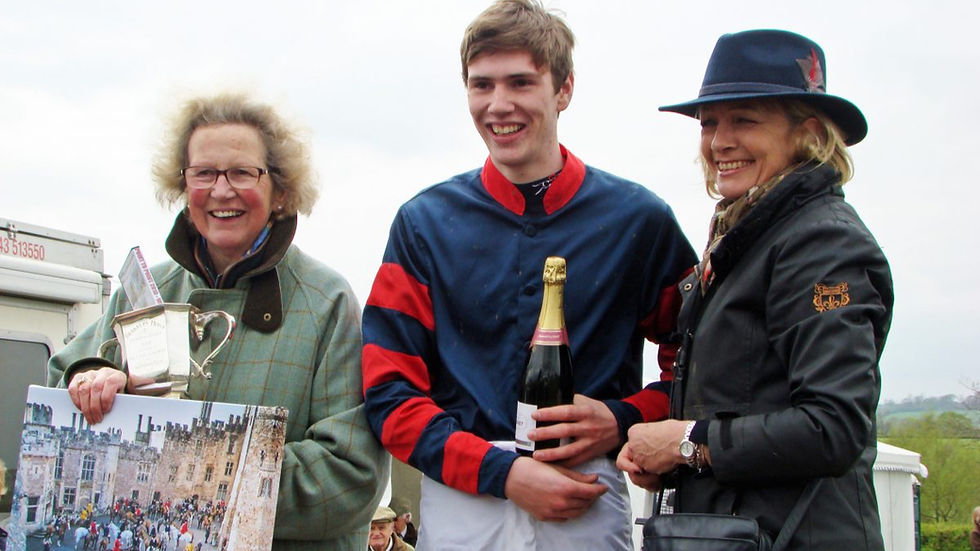
Tom explains how he got into the sport of racing. “I’m from Little Comberton, near Pershore in Worcestershire. I grew up with ponies and did a lot of hunting. Mum was a member at Cheltenham, so I used to go with her, and Dad was really into his pointing – Chaddesley Corbett and Upton-on-Severn were our local tracks. I pony raced – I had two winners at point-to-point tracks and one at Cheltenham, riding against the likes of Alice Stevens and Sam Lee. I loved it and thought I wanted to be a jockey.”
Tom is matter of fact about the reason he retired from the saddle aged just 22, after the sole winner (at Woodford in 2019) from about 50 rides. “I wasn’t good enough,” he shrugs. “And only got round twice in my last season. I did it for enjoyment, and weight wasn’t really an issue (Tom must be at least 6’3”), although I struggled to do 11st 2lbs with the allowance in Mixed Opens.” In any case, training was already on the cards.
“I used to ride out for Tony Carroll and went to Philip Hobbs for two summers, as some friends were in a syndicate with him,” recalls Tom. “I was supposed to go to university, the Royal Agricultural College, but never made it. I went to Nicky Henderson’s for the summer and didn’t leave. I was there for two years, when he had the likes of Altior, Santini and Shishkin, then became pupil assistant to Oliver Sherwood, then to David Dennis.”
Tom confirms how the move to Shropshire came about. “Alastair gave me the opportunity to be his assistant, so I moved here in 2022. I kept my pointers there for a year before taking on this place.” However, after three years, working full-time for Ralph didn’t leave Tom enough time to train his own pointers. “I’d go to Alastair’s at 7am, work all morning, rush back here at lunchtime, ride as many lots as I could, then go back to Alastair’s at 4pm for evening stables. There was lots of toing and froing!”
Unsurprisingly, Tom’s gained a lot from his various roles, starting with his time at Seven Barrows. “I’ve learnt to leave room to work on the horses early in the season so they’re ready for the big targets in the spring, and to keep them fresh and well throughout the season. Nicky’s not hard on his horses, but it’s difficult to train like him – there’s a new breed of owner who wants results more quickly.”
Tom expands on his thinking. “French-breds, broken-in as yearlings, have become popular, and don’t seem to have as much longevity as stores coming from pointing, which has more of an effect than people realise. When I started going racing, the likes of Denman and Big Bucks would go to the Festival year after year and perform every time. Lots of horses now have just one good year and we’re breeding horses to become more precocious – many National Hunt horses are flat-bred and not as many want soft ground.”
As Tom admits, he’s been lucky to have two good horses in his care, firstly What A Glance, who had looked more of a two-and-a-half miler who wanted better going, until winning over 3m2f in bottomless ground at Cheltenham! “He’s always worked like an aeroplane at home,” laughs Tom again, “And he’s out of a seven-furlong mare, so I got stuck on the idea that he wouldn’t get three miles. But he was hitting the line strongly over two-and-a-half but not quite getting up. He’d been running well in points against the likes of Ihandaya and Deise Aba, and I didn’t think the Cheltenham race was the strongest of the night.”

However, the soft conditions nearly scuppered Tom’s plans. “Rider Murray Dodd and I walked the course, and it was horrifically wet – I fell out with my girlfriend, who didn’t think he should run – so I told Murray to drop him out and pull up if he hated the ground, but he loved it. We then went to Stratford because he was in great form, and you don’t get many chances at the Horse & Hound. It was over even further and there was still plenty of cut, but he won again.”

Last year, What A Glance was never right, and he cracked a splint bone in the Cheltenham Foxhunters. “We’ll see how we go,” says Tom cautiously. “He’s unlikely to go back to the Festival and we’ll work towards the Cheltenham and Stratford evening meetings again. He’ll probably go to Ludlow early next month, (where he was going well when falling four out) then maybe for the Walrus at Haydock.

Tom tells me how he obtained Ocean Drifter, his other stable star. “He had good form under rules for Oliver Sherwood but was fragile. Oliver and owner Tim Syder gave him to Cameron Johnstone-Baker – we worked together when I was there – and, when Cameron moved to Emma Lavelle’s, he asked if I’d like him.”

“Clara (Brewitt) gets on well with him,” continues Tom, “And won’t get off him in a hurry! He’s got a non-rules agreement, so we’ll stick to points. Frustratingly, many of the big races are Mens Opens – we can’t run him with Clara in the Lady Dudley Cup – so he’ll keep running in Ladies Opens.

Tom talks through his other pointers. Suttons Hill showed good form under rules in Ireland without winning and has been placed, after front-running, on both his British starts. “We may need to change the tactics with him,” admits Tom. (He was held up at Cocklebarrow but was hampered and unseated Clara).

“Amnidnightstar won a hurdle at Hereford but has had two years off. She’s doing things right and seems OK now. She’s owned by Lynn Wallace, another great help to the yard. Impact Player ran in a bumper for Gary Moore. He was green and backwards, is well bred, and will improve for further and fences. And Grass’s Jet came just last week – (owner-rider) Will Badlan sent him to me. He’s a maiden, who’s been in the wilderness, and I’m still figuring him out.”

With Murray Dodd, and Toby McCain-Mitchell, who rode What A Glance last year, having turned conditional, Fred Philipson-Stow will ride the horse this year, and Tom confirms how he chooses his jockeys. “People I get on with and people who come in and ride out,” he states firmly. “Both Fred and Clara help out, they listen, and they give good feedback. Fred’s riding with confidence, gets his horses settled and jumping, and is very talented. He probably under-rates himself. It’s the same with Clara – she’s really improved since she started riding Ocean Drifter.”
I ask Tom if he’s thought about going down the young horse sales route so popular at the moment. His response is frank. “Potentially down the line, but you need the time to do them properly and, working at Alastair’s, time is something I don’t have. Older horses are easy – you just tack up and ride them out!”
However, it seems that Tom may soon be lost to pointing. “I’ve done my first two licenced trainer modules, with the third next month,” he tells me. “I’m looking for a yard, then I’ll apply for a licence. While Ocean Drifter will obviously stay pointing, you need plenty of ammunition when you’re starting out under rules, so the others will come with me.”
Tom explains the reasons behind his decision. “I love pointing, it’s not as serious, everyone’s more relaxed, and it’s more fun. But from a business perspective, I have to make money and – while I try to keep the costs down – there’s no incentive to own pointers. Even when you’re buying and selling young horses, it’s hard to make a go of it – you might sell one for £100,000, but you probably need to buy five to find that one. You need a syndicate of backers who can afford to lose money and it’s a gamble at the end of the day, a big gamble. There’s a lot of pressure to deliver and I like to find a consistent horse who can give the owners a fun day out.
As Tom obviously has strong views on pointing, I ask my usual question about what he’d do if he was in charge of the sport. “I don’t know,” he confesses. “It’s a difficult one. The biggest problem facing the sport is if hunting gets banned, as you’d lose a lot of free support and help, and we’d struggle to finance what the hunts do. I’d try to find a big national sponsor – maybe one of the sales companies – but that’s easier said than done.”
He has mixed views on the new social media approach that the PPA is taking. “It certainly appeals to young people,” confirms Tom, “And gets the sport across to a wider audience. But those people can’t afford to have a horse in training and that’s what you need – if you’re struggling to buy a house, you can’t afford a horse!”
So how do you get more young riders into pointing, Tom? “There are lots of them who’d love to ride in a race,” he answers. “So, could you allow, say, a trainer to give some of his horses to his staff, to train and ride in points? You’d have to put a cap on the number of horses, and their level – maybe up to three, rated no higher than 110. I know a lot of pointing people are against professional trainers, but it’s even harder to get a ride under rules and it would be a cheaper way to get people involved.”
Tom’s final word comes in response to my question of what would happen to him in a world without racing. His reply is simple – “I wouldn’t know what to do!”


Comments